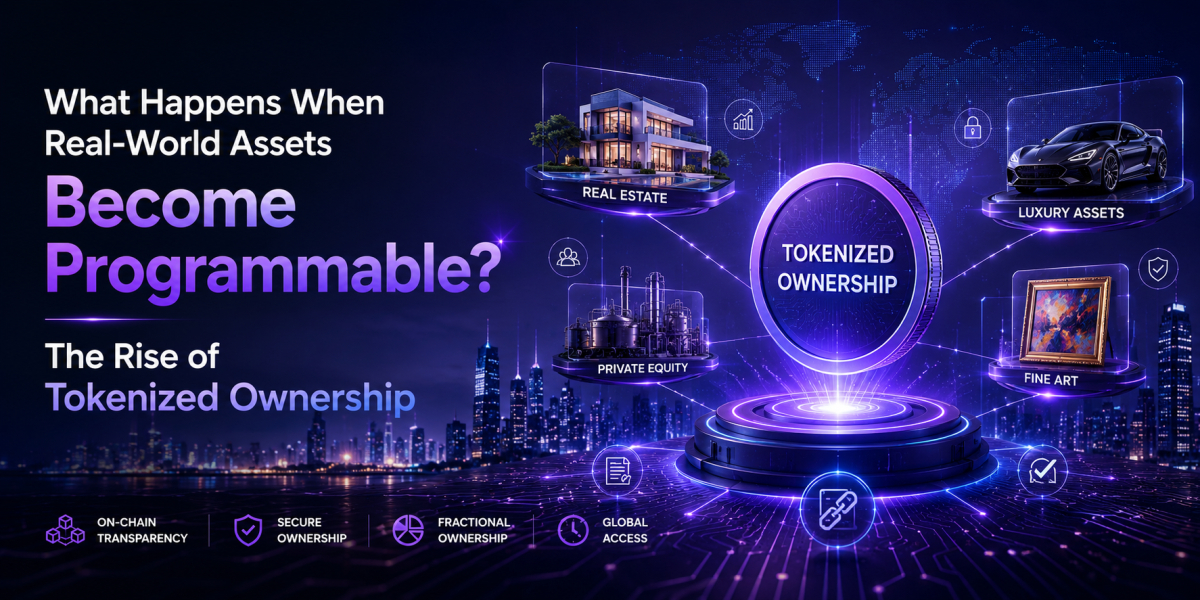
Traditionally, real world assets have been handled using paper, contracts, centralised databases, and several intermediaries. From property, private credit instruments, commodities, and investment funds, ownership or transactions rely on systems that predate the emergence of blockchain technology.
There is another method of dealing with this: tokenization. Objects can be tokenized to showcase ownership, transfers and the associated rights in a digital infrastructure, using blockchain as a vehicle. With the addition of smart contracts to the model, some processes can be programmed.
This raises an important question: What actually happens when real-world assets become programmable?
The solution is so much more than just turning a physical asset into the digital token. It also encompasses the rethinking of the representation, transfer, management and potential automation of ownership.
What Does Programmable Ownership Actually Mean?
Programmable ownership allows for the linking of digital rules or conditions ahead of time to an asset or its representation on a blockchain.
Transferring an asset in a conventional system could take a couple of steps. Distinct systems to verify identities, prepare documentation, update records, determine eligibility, and process payments must be operational. They can be executed by several organisations – and require manual coordination.
Some of these processes can be potentially linked with each other using tokenized assets and smart contracts. A Smart Contract is a blockchain-based application that runs specific instructions in the event of specific conditions.
For example, the rule on a token for an investment interest might be, "The token may be used by only Manhattan account holders, transfers must be executed only by their account holders, and some payments may only be taken by certain rules. The blockchain records relevant transactions, not to mention the rules encoded into the system which are governed by the smart contract.
But programmability doesn't necessarily imply legal ownership. The Contractor will still need to sign a legal contract that will link the token to the underlying asset.
How Do Real-World Assets Become Digital Tokens?
Converting a physical resource into a token is not as simple as making a virtual representation.
1) Identifying the Underlying Asset
The first part is to figure out what is being tokenized. These may be real estate, private credit, commodities, funds, infrastructure or something else.
Before creating a representation of the asset, the asset must be identified and verified effectively.
2) Establishing Legal Rights
The token should have a known linkage to the asset.
Under the law, agreements can define the rights of the token holder, who will retain ownership, and what will happen with the underlying asset if it is sold, transferred or otherwise changed.
3) Creating the Digital Representation
After legal and operational structure is put in place, the asset can be tokenized with blockchain technology.Legal and operational structure is in place, the asset can be tokenized using blockchain technology.
The token may include or reference details of the asset, the terms of asset transfer, who's in charge of the asset, and other aspects.
4) Connecting the Token to the Asset
This is one of the most crucial steps involved in tokenization.
A real world asset can only have a reliable linkage in the real world if it has a useful blockchain token to represent it. These include custody agreements, legal frameworks, asset verification and off-chain records.
5) Managing the Tokenized Asset
Once issued, there is a need for asset management.
These can include investor inducement, transfers, distributions, compliance and reporting activities, among other things. Parts of these processes can be automated using blockchain and smart contracts.
The Role of Smart Contracts in Tokenized Ownership
Programmable ownership can be achieved with several technologies, and smart contracts are one of these.
Developers can define rules that can attach to how a token acts, rather than just being a digital record of the token. These rules may exist to regulate transfers, eligibility, the amount of payouts within a pre-defined process, and other similar arrangements per design.
For example, let's say there's a tokenized investment that pays out regular income. A smart contract could be created to pay back according to the intended ownership records and stipulations.
Likewise, the transfer protocol may be set to restrict transactions from taking place until they satisfy other conditions that must be met.
Not all processes need to be automated. Some decisions must be made by humans, be legal or use information that is not on the blockchain. Effective systems will probably require blending in the blockchain automation aspect plus the proper off-chain systems.
What Changes When Ownership Moves On-Chain?
The ability to move asset ownership onto blockchain infrastructure could alter the way assets are managed.
Clusters of centralized databases are typically involved in traditional asset ownership. Participants may have their own records and this may necessitate a record reconciliation between records maintained by different participants.
Authorised participants can then refer to relevant records from the same underlying ledger using blockchain to provide a shared transaction history.
This may help to enhance transparency and minimize some types of administrative duplication.
Another possible transformation is the efficiency of transactions. The tokenized infrastructure can link ownership registries and transaction logic in a shared virtual space, rather than responding to multiple standalone systems.
But, not all transactions on blockchain are cheaper or faster. The real-life experience depends on network design, regulations, custody protocols, conformity systems and system architecture.
The important transformation, however, is not only the speed. The ability to define an asset representation that can communicate with digital rules and applications.
Can Compliance Become Part of the Asset?
Programmable compliance is one intriguing option.
Old compliance procedures are typically managed in parallel with other systems. Some verification and investor qualification, some monitoring of transactions, some restrictions on transfers, before or after the transaction.
Some of these requirements may be embedding themselves within the flow of transactions through tokenized infrastructure.
For instance, it may be programmed to only be adapted to list approved addresses who are allowed to receive them. Restrictions based on investors' eligibility or geographic location may also apply in the context of transferring rules.
This method may help to better align compliance with the asset.
But it varies state by state, asset type by asset type and investor type by investor type. This means compliance can't just be solved with a smart contract. There are still to be legal and regulatory processes to clarify which rules may be applicable and how they should be realized.
Where Could Programmable Tokenized Ownership Be Used?
Programmable ownership of assets can be used in multiple classes of real-world assets. With blockchain records linked to smart contracts, enterprises can generate digital emulations of their assets, and automate certain tasks including managing investor relations, compliance inspection, and payments.
1) Real Estate
One of the key use cases of tokenization is the real estate sector. A property may have several digital representations – each token may represent a specific economic ownership. This can enable fractional ownership, and keep a digitized log of who owns what and has traded what.
A white label real estate tokenization platform development company can build customizable infrastructure for businesses to issue and manage tokenized properties. Features on these platforms can include investing, payments to investors, distribution, investor onboarding, token issuance, and compliance management.
2) Private Credit
A programmable tokenization can help to digitally represent investment interests in loans or other debt instruments in the benefit of private credit. The use of smart contracts may streamline and automate activities that are defined in advance, like paying interest and providing dividends, while the blockchain keeps records of these transactions.
This can make it more efficient to cut down some of the administrative processes and give investors a take care of the document of their investment.
3) Commodities
Digital tokens can also be associated with physical securities like precious metals, energy resources, and agricultural products. The token can stand for textual definition of a claim or an economic interest in the underlying asset.
Blockchain can be used to manage transactions and custody and verification systems can ensure that the digital representation is linked to the physical good.
4) Investment Funds
Tokenization enables an investment fund to tokenize shares of its investors interests. Blockchain-powered ownership tracking can streamline the tracking of ownership, and smart contracts can automate specific aspects of the transactions, like restrictions on transfers and distributions.
This can lead to a more programmatic setting that allows for better investor participation control.
5) Other Assets
Tokenization may be applied to other assets, like infrastructure, collectibles, carbon or Intellectual Property. Such assets can be enabled with digital asset records, clear transaction history and programmable rules as applicable.
Finally, whether or not an asset is suitable for tokenization will depend on its legal makeup, regulatory needs, custody requirements, and whether blockchain technology offers any benefits over existing solutions.
What Are the Potential Benefits?
Programmable ownership can provide a number of potential benefits.
1) Greater Transparency
The type of blockchain and blockchain platform used can allow for the creation of a consistent transaction and ownership timeline.
2) Process Automation
Smart contracts can enable predefined actions without necessarily requiring manual involvement in appropriate processes.
3) Fractional Participation
Depending on the asset's structure and regulations, tokenization can enable the fractionalization of assets, reducing the entry barriers for participation.
4) Improved Administrative Efficiency
Repetitive administrative tasks can be minimized by linking ownership, transaction and compliance processes with digital infrastructure.
5) New Financial Models
Programmable assets can enable new ways of thinking about ownership, investment leading to settlement, and asset management, which can be hard to achieve in more traditional systems.
These advantages should be considered as possibilities, however, and not guaranteed benefits. Even a poorly designed tokenization system can cause complexity and inefficiency.
The Challenges Behind Programmable Ownership
Numerous challenges arise with the move from traditional ownership to programmable assets.
What Could the Future of Tokenized Ownership Look Like?
The following level of tokenization extends beyond the idea of only representing assets on the blockchain.
Going forward, tokenization will increasingly be tied to financial managemeant applications, regulatory compliance, custody, etc., identity solutions, and automated settlement networks.
This might lead to a more integrated and digitized space in which different kinds of assets can interact in different ways, under certain rules.
For example, a tokenized financial asset might engage with, and be compatible with, the mechanisms of lending, payment systems or portfolio-management apps and remain compliant with established rules.
In the coming years, as various tokenization ecosystems evolve and grow, a lack of interoperability will likely become increasingly critical. Companies can think about moving to platforms that communicate with different networks and interconnect with current financial systems rather than individual platforms.
So the wider opportunity isn't simply the act of bringing on-chain assets to them. It is taking the approach to establish a digital layer that enables the representation, management and interaction with assets more efficiently.
Conclusion
Real-world asset tokenization is a paradigm shift in the way asset ownership and management can be approached in a digital economy.
The most important opportunity might not be related to the token directly. It is derived from the integration of blockchain records along with smart contracts, legal contracts, compliance, custody, and application that can interact with tokenised assets.
As ownership can now be programmed, some processes may shift from manual coordination to predetermined processes in the digital format. Transfer, eligibility checks, distributions, and other activities can be streamlined, tailored to meet legal and technological requirements.
At the same time, tokenization does not eliminate the complexities of real-world ownership. The key issues associated with regulation, legal rights, asset custody, asset valuation, security and market demand continue to be important.
As blockchain technology advances, its ability to integrate with the real-world systems that provide assets with value, rights, and economic utility will be the key to the evolution of tokenized ownership.
.png)
.jpg)
.jpg)
.jpg)
.jpg)
_(1).jpg)
.jpg)
.jpg)
.jpg)
.jpg)